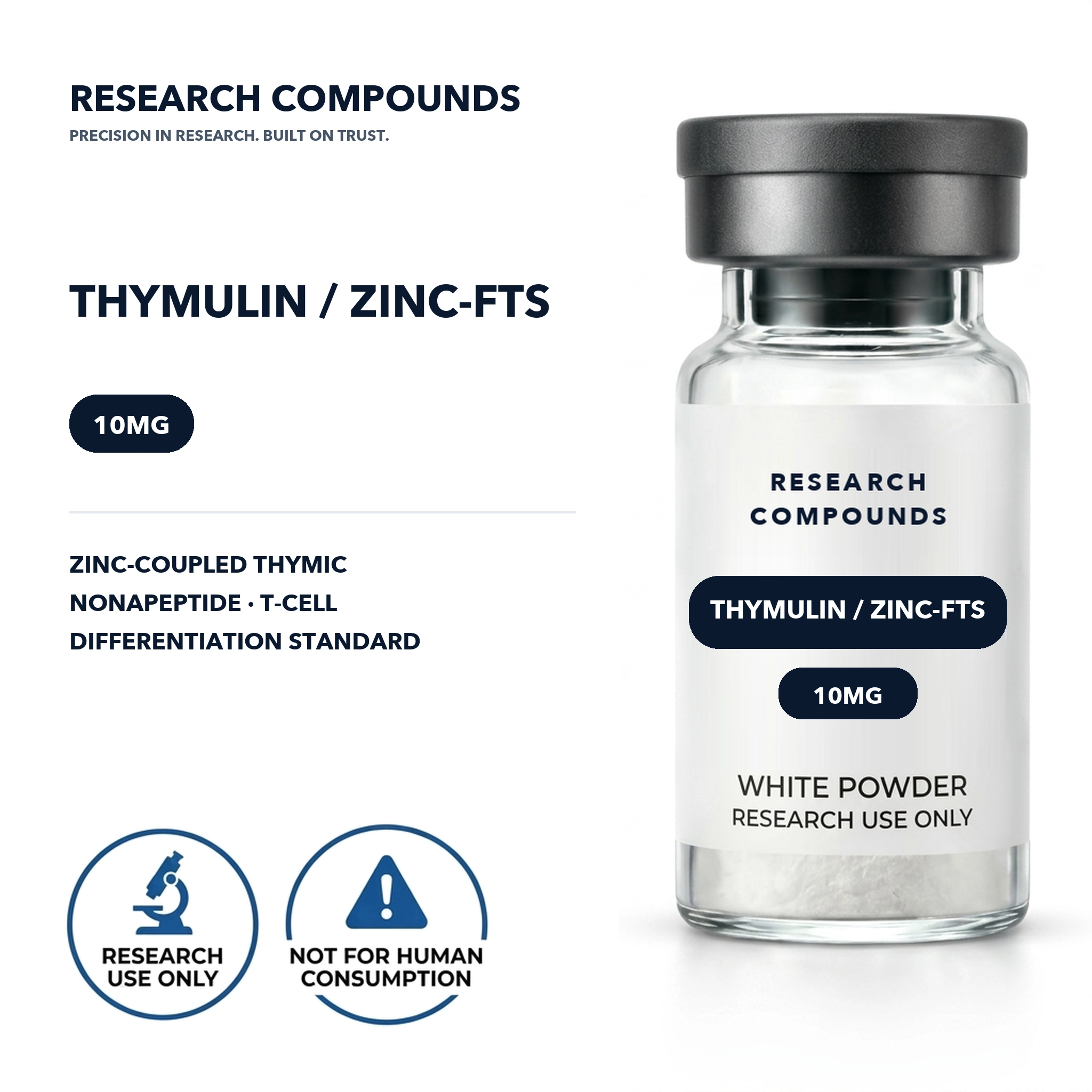
Thymalin (10mg Natural Thymic Complex)
Analytical Standards & Laboratory Handling
Verified laboratory protocols, reconstitution parameters, and handling guidelines.
Pharmacological Profile & Mechanism of Action
### Section I: Molecular Structure, Bioregulation & Peptide Chemistry Thymalin is an authoritative natural peptide bioregulator complex isolated from juvenile bovine thymus tissue via multi-stage acetic acid extraction, membrane ultrafiltration (<10 kDa cut-off), and chromatographic fractionation. Standardized as a sterile lyophilized preparation of low-molecular-weight thymic signaling polypeptides (1–5 kDa, average ~5,000 Da), Thymalin contains an authentic stoichiometric spectrum of organotypic bioregulatory motifs—predominantly Glu-Trp (EW) dipeptide clusters, thymopoietin-like peptide sequences, and endogenous zinc-coordinating residues. Unlike synthetic single-epitope nonapeptides such as Thymulin (FTS), Thymalin functions as a physiological multi-peptide matrix that induces targeted gene transcription in lymphopoietic stem cells without requiring artificial adjuvant carriers.
### Section II: Nanomolar Pharmacodynamics & T-Lymphocyte Receptor Kinetics At the cellular level, Thymalin engages specific high-affinity membrane receptors on bone marrow-derived pluripotential stem cells and early thymocytes, initiating intracellular phosphorylation cascades via the JAK-STAT and MAPK/ERK pathways. This signaling directs the differentiation, proliferation, and phenotypic maturation of uncommitted precursor cells into immunocompetent T-lymphocyte lineages. Flow cytometric analyses confirm the induction of CD3+, CD4+ (T-helper), and CD8+ (cytotoxic) differentiation markers, restoring homeostatic CD4+/CD8+ ratios in immune-compromised models. Concurrently, Thymalin activates FoxP3+ regulatory T-cell (Treg) expansion, attenuates aberrant NF-κB nuclear translocation, and downregulates systemic pro-inflammatory cytokines (IL-1β, IL-6, TNF-α) while preserving protective antiviral interferon-gamma (IFN-γ) and interleukin-2 (IL-2) secretion.
### Section III: Pharmacokinetics, Systemic Bio-distribution & Clearance Following parenteral subcutaneous or intramuscular administration, Thymalin undergoes rapid vascular and lymphatic uptake, reaching peak plasma concentration (Tmax) within 30 to 60 minutes. The active peptide fragments exhibit an effective circulating elimination half-life (t1/2) of approximately 2 to 4 hours in blood plasma. However, the epigenetic transcriptional shifts and cellular phenotypic changes initiated in bone marrow progenitor pools persist for 3 to 6 months post-cycle. Metabolic clearance proceeds through ubiquitous vascular and tissue neutral endopeptidases (NEP/CD10) and cytosolic aminopeptidases, yielding native non-toxic L-amino acids eliminated via renal filtration with zero hepatic cytochrome P450 interaction.
### Section IV: Clinical Indications, Longevity Horizons & Preclinical Benchmarks Characterized by the St. Petersburg Institute of Bioregulation and Gerontology under Professor Vladimir Khavinson, Thymalin has been evaluated across multi-decade randomized trials for age-associated thymic involution (immunosenescence), secondary immunodeficiency states, chronic infectious syndromes, post-chemotherapy lymphopenia, and severe acute respiratory distress syndrome (ARDS) models. Preclinical longevity studies demonstrate a 1.5- to 2.1-fold reduction in spontaneous neoplastic incidence and substantial extension of average lifespan through the normalization of endocrine-immune crosstalk and baseline inflammatory homeostasis.