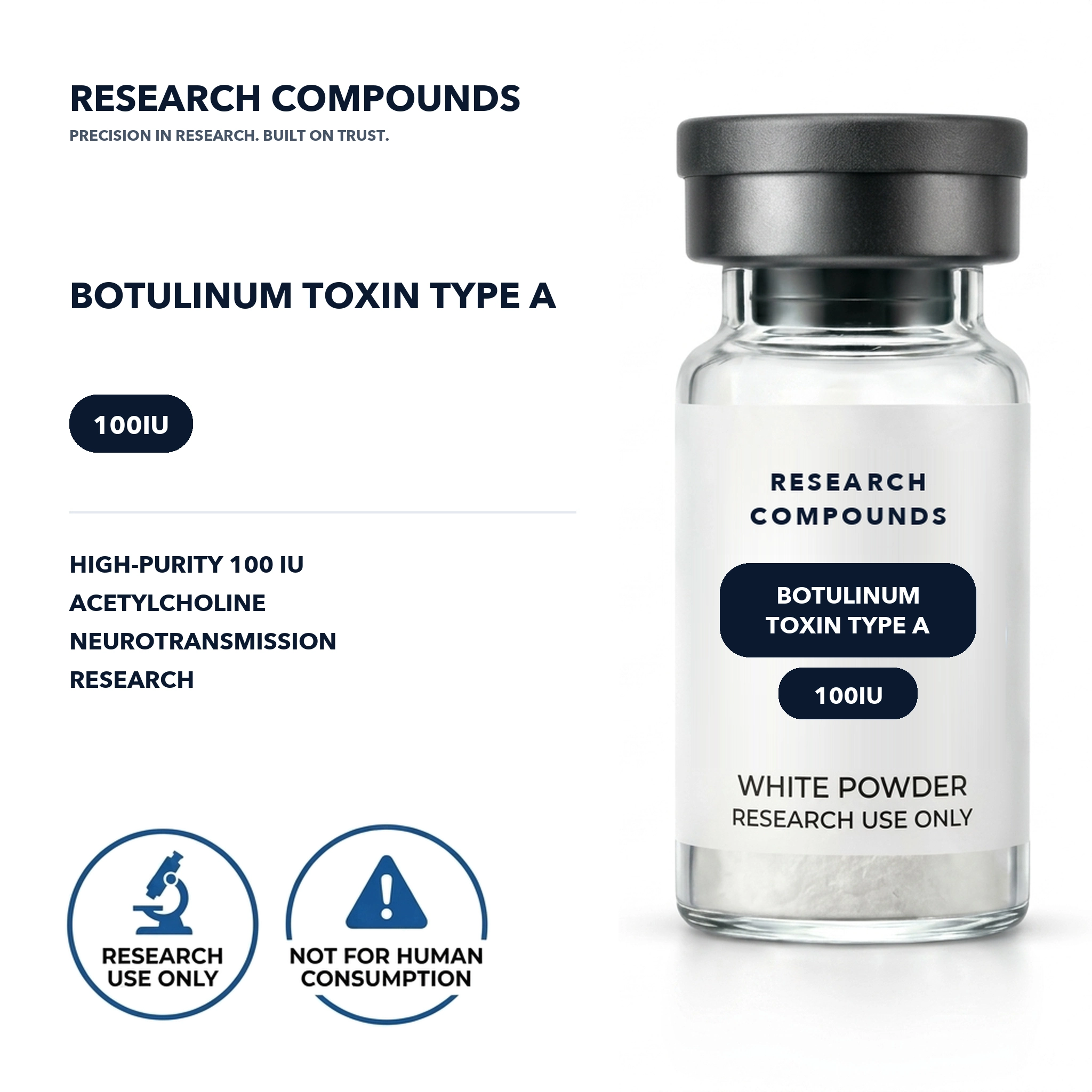
Botulinum Toxin Type A (100 IU Research Standard)
Analytical Standards & Laboratory Handling
Verified laboratory protocols, reconstitution parameters, and handling guidelines.
Pharmacological Profile & Mechanism of Action
### Section I: Molecular Bio-Engineering & Quaternary Protein Structure Botulinum Toxin Type A (BoNT/A) is an ultra-pure 150 kDa dichain holoprotein neurotoxin produced by anaerobic fermentation of Clostridium botulinum (Hall strain). The active holoprotein consists of two distinct polypeptide subunits joined by a single critical disulfide bridge between Cys429 and Cys453: a 100 kDa Heavy Chain (HC) responsible for picomolar cell-surface recognition and endosomal pore formation, and a 50 kDa Light Chain (LC) functioning as an extraordinarily specific zinc-dependent metalloprotease. Stabilized as a vacuum-dried analytical standard containing 100 International Units (IU) of biological activity, BoNT/A is calibrated in mouse LD50 units (1 IU ≈ 40 pg pure neurotoxin) for precision laboratory research.
### Section II: Picomolar Dual-Receptor Binding & SNARE-25 Cleavage Kinetics BoNT/A mediates a sequence of four discrete molecular events at peripheral cholinergic motor endplates: (1) High-affinity dual-receptor coordination: The C-terminal domain of the heavy chain binds polysialogangliosides (GT1b/GD1a) on the presynaptic neuronal membrane before binding synaptic vesicle protein 2 (SV2A/B/C isoforms) during vesicle recycling; (2) Clathrin-dependent endocytosis into synaptic vesicles; (3) pH-dependent membrane pore translocation: Acidification (pH 5.0–5.5) triggers a conformational switch in the N-terminal heavy chain domain, driving the 50 kDa light chain across the endosomal membrane into the cytosol; (4) Intracellular catalytic endopeptidase action: The zinc light chain selectively cleaves the 197-Gln—198-Arg peptide bond of Synaptosomal-Associated Protein 25 (SNAP-25). This truncates 9 amino acids from SNAP-25, preventing functional ternary SNARE complex assembly and arresting calcium-triggered exocytosis of acetylcholine vesicles.
### Section III: Pharmacokinetics, Local Depot Persistence & Motor Endplate Recovery Following localized micro-injection into target neuromuscular tissue, BoNT/A remains sequestered at the local injection site with negligible systemic vascular bioavailability. Unbound circulating toxin in plasma has a brief half-life (t1/2) of 30 to 120 minutes, cleared by hepatic Kupffer cells and splenic macrophages. Conversely, the internalized catalytic light chain within motor nerve terminals demonstrates remarkable cytoplasmic longevity, resisting proteasomal degradation and maintaining active SNARE inhibition for 3 to 6 months. Functional neuromuscular recovery progresses through two phases: collateral axonal sprouting forming functional accessory motor endplates at 4 to 8 weeks, followed by gradual ubiquitination of the light chain, clearance of cleaved SNAP-25, and restoration of original synaptic terminal transmission at 12 to 24 weeks.
### Section IV: Research Horizons, BSL-2 Containment & Chemical Neutralization BoNT/A serves as the global scientific reference standard for investigating synaptic vesicle trafficking, focal dystonias, autonomic sweat gland kinetics, and neuropathic pain transmission (via co-inhibition of Substance P and CGRP release in primary sensory neurons). Research handling must strictly comply with Biosafety Level 2 (BSL-2) biocontainment guidelines. Complete chemical decontamination and inactivation require exposure to freshly prepared 0.5% sodium hypochlorite (household bleach diluted 1:10) for 30 minutes or autoclaving at 121°C for 30 minutes. Strictly designated for In-Vitro Laboratory Research and Non-Clinical Analytical Investigation (RUO).